Views: 0 Author: Site Editor Publish Time: 2026-09-16 Origin: Site
Cranes need cables that can transmit power, control signals, and communication data while moving continuously. Unlike fixed-installation cables, crane cables must withstand repeated bending, pulling force, abrasion, acceleration, and mechanical stress.
Two of the most common solutions are reeling cables and festoon cables:
A reeling cable is wound onto and released from a rotating drum.
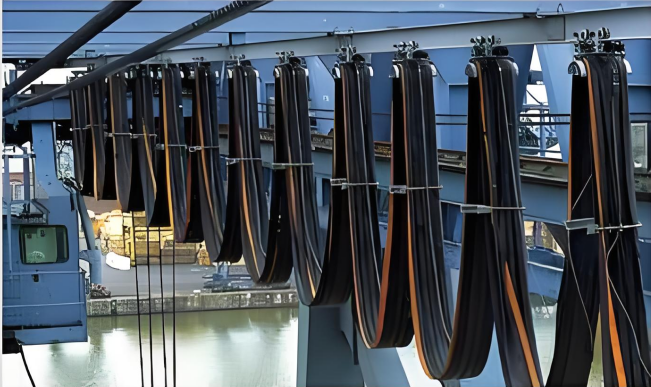
A festoon cable moves in suspended loops supported by trolleys along a track.
Neither solution is automatically better. The correct choice depends on the crane’s movement, travel distance, operating speed, available space, electrical load, and working environment.
In simple terms: Reeling cables are generally suited to long-travel, outdoor, mobile, and medium-voltage applications. Festoon cables are often better for indoor cranes with short or medium travel distances and fixed trolley tracks.
Table of Contents
Requirement | Reeling Cable | Festoon Cable |
|---|---|---|
Cable movement | Wound onto a drum | Suspended in loops |
Typical travel | Long travel distances | Short or medium travel |
Common location | Ports, mines, shipyards, outdoor machinery | Factories, warehouses, workshops |
Main mechanical stress | Bending, tension, abrasion, torsion | Repeated bending and loop movement |
Installation structure | Drum and tension system | Track, trolleys, and clamps |
Voltage options | Low- and medium-voltage | Mainly low-voltage power, control, and data |
Space requirement | Drum installation space | Track and vertical loop space |
Typical maintenance | Drum, winding, and tension | Track, trolley, clamp, and loop |
This comparison provides a starting point, but the final cable selection must be based on the actual operating conditions.
A reeling cable is stored on a rotating drum that releases the required length as the crane or trolley moves away from the power source and winds the cable back when the equipment returns. This system is commonly used on port and gantry cranes, ship loaders and unloaders, mining machinery, mobile industrial equipment, spreader and lifting systems, and metallurgical machinery. Because the cable is stored directly on the equipment, a reeling system does not require a long support rail along the entire travel route, making it a practical solution for large outdoor machinery and long-travel applications.
However, the cable must be designed for the drum diameter, winding direction, tension, operating speed, and expected number of cycles. An incorrect drum size or unstable winding pattern can cause excessive stress and premature jacket damage.
RONA’s reeling cable range includes low- and medium-voltage solutions for cranes, ports, spreaders, mining machinery, and other mobile equipment.
A festoon cable operates on a track or beam. The cable hangs in loops between several trolleys. When the crane moves, the trolleys travel along the track and the cable loops extend or retract.
Festoon systems are frequently used for:
Overhead cranes
Bridge cranes
Workshop lifting equipment
Material-handling systems
Tunnelling machinery
Indoor production lines
Flat cables are common in festoon systems because their conductors are arranged side by side. This helps reduce twisting and allows the cable loops to move more predictably. Round festoon cables may also be used when required by the equipment design.
RONA’s festoon cable range includes flexible power, control, communication, and flat travelling cables for cranes and industrial machinery.
A reeling cable is usually more suitable when the crane travels over a long distance or operates in an outdoor environment. Ports, mines, shipyards, and mobile industrial equipment often benefit from drum-based cable storage.
A long festoon system would require more trolleys, a longer rail, and additional space for hanging loops.
Festoon cables are commonly used for workshop cranes, overhead cranes, and bridge cranes operating along a fixed runway. Their structure is easy to observe, and the cable movement can be managed through trolley spacing and loop length.
Festoon loops extend below the supporting rail. They may interfere with loads, walkways, machinery, or building structures.
When vertical clearance is limited, a reeling system may be more practical if there is enough room for the cable drum and tension-control equipment.
Large cranes and mobile machinery may require medium-voltage power transmission. Specially designed reeling cables are commonly used for these applications because the cable must handle both electrical requirements and continuous mechanical movement.
Festoon systems are useful when a crane needs several separate power, control, signal, and communication cables. The cables can be arranged together on the same trolley system.
Before choosing the cable, the following information should be provided to the cable supplier:
Category | Required information |
|---|---|
Movement | Horizontal, vertical, lifting, or combined movement |
Travel | Total distance and available cable length |
Speed | Normal and maximum operating speed |
Acceleration | Starting and stopping conditions |
Flexing | Required cycles and bending frequency |
Mechanical load | Cable weight, tensile force, and possible torsion |
Installation | Drum diameter, trolley spacing, track layout, or loop length |
Electrical design | Rated voltage, current, conductor size, and number of cores |
Signal requirements | Control cores, shielding, communication, or fibre optics |
Environment | Rain, UV, saltwater, oil, dust, chemicals, and temperature |
The cable must also have a suitable minimum bending radius. A cable that is technically flexible may still fail if it is installed around a drum or trolley system that is too small.
If the application includes torsion, this must be specified clearly. An ordinary festoon cable or standard reeling cable should not be expected to withstand uncontrolled twisting.
Cable selection and mechanical installation cannot be separated. In a reeling system, the drum diameter, winding direction, cable alignment, tension control, cable stacking, overlap, and connection points must be correctly matched, while the cable should also be checked regularly for twisting and abrasion. In a festoon system, trolley spacing, track alignment, loop length, cable clamps, trolley wheels, bearings, bending points, and contact with nearby structures all affect cable performance. Regular inspections should identify jacket damage, flattening, exposed conductors, abnormal wear, and changes in cable movement, while maintenance should cover both the cable and its supporting equipment.
RONA provides flexible cable solutions for reeling systems, festoon systems, cranes, ports, mining equipment, industrial plants, and other heavy-duty machinery.
Its product range includes reeling cables, festoon cables, flat travelling cables, flexible power cables, control cables, communication cables, and medium-voltage solutions. Selection can be based on movement type, voltage, mechanical load, travel distance, installation structure, and working environment.
You can view RONA’s industrial cable product categories for additional cable options.
Yes. The cable jacket and supporting system must be suitable for ultraviolet radiation, rain, temperature changes, oil, dust, and other local conditions.
Special reeling and spreader cables can support vertical lifting. Cable weight, tensile force, operating speed, drum design, bending radius, and torsion must be evaluated before selection.
Festoon systems may have a simpler mechanical structure, but both systems require regular inspection. Reeling systems require drum and tension checks, while festoon systems require inspection of tracks, trolleys, clamps, and cable loops.
No. Crane cables should be specifically designed for reeling or festoon movement. The bending radius, tensile load, operating speed, flexing cycles, and environmental resistance must match the application.
Neither reeling nor festoon cable is universally better; the right choice depends on how the crane moves, where it operates, and how the cable is supported. Reeling cables are often the more practical solution for long-travel cranes, outdoor mobile machinery, port and mining equipment, ship loaders, spreader systems, and metallurgical machinery because they wind onto a drum, require limited installation space, and can support long travel distances and medium-voltage power transmission. Festoon cables are generally better suited to indoor overhead cranes, workshops, warehouses, and other applications where the equipment follows a fixed trolley track over a short or moderate distance and needs to carry several separate power, control, or communication cables. Before making a decision, the complete operating conditions should be reviewed, including travel distance, running speed, drum or track arrangement, available clearance, electrical load, cable weight, bending or torsional stress, environmental exposure, and maintenance access. Selecting the cable system according to these factors can improve service life, reduce wear and unplanned downtime, and deliver more predictable long-term operating costs.