Views: 0 Author: Site Editor Publish Time: 2026-09-16 Origin: Site
PUR and PVC are two common sheath materials used in industrial cables. Both can protect conductors and support reliable power, control, and signal transmission, but they perform differently under abrasion, repeated movement, oil, chemicals, temperature changes, and outdoor exposure.
PVC cable is usually an economical choice for indoor machinery and moderate operating conditions. PUR cable is often preferred for continuous movement and harsher industrial environments, provided that the complete cable construction is designed for these conditions. The right choice depends on the cable structure, movement pattern, working environment, and expected service life.
Table of Contents
Selection factor | PUR cable | PVC cable |
|---|---|---|
Abrasion resistance | Excellent | Good |
Flexibility | Very good for dynamic use | Good when designed for flexing |
Oil resistance | Generally excellent | Moderate to good |
Chemical resistance | Suitable for demanding environments | Suitable for common industrial conditions |
Low-temperature performance | Usually better | More limited |
Outdoor use | Often suitable | Requires confirmed UV and weather resistance |
Cost | Higher initial cost | More economical |
Typical application | Robots, drag chains, outdoor machinery | Indoor machinery, control wiring, moderate movement |
These are general differences. Actual performance depends on the cable compound, conductor structure, insulation, shielding, bending radius, and installation conditions.
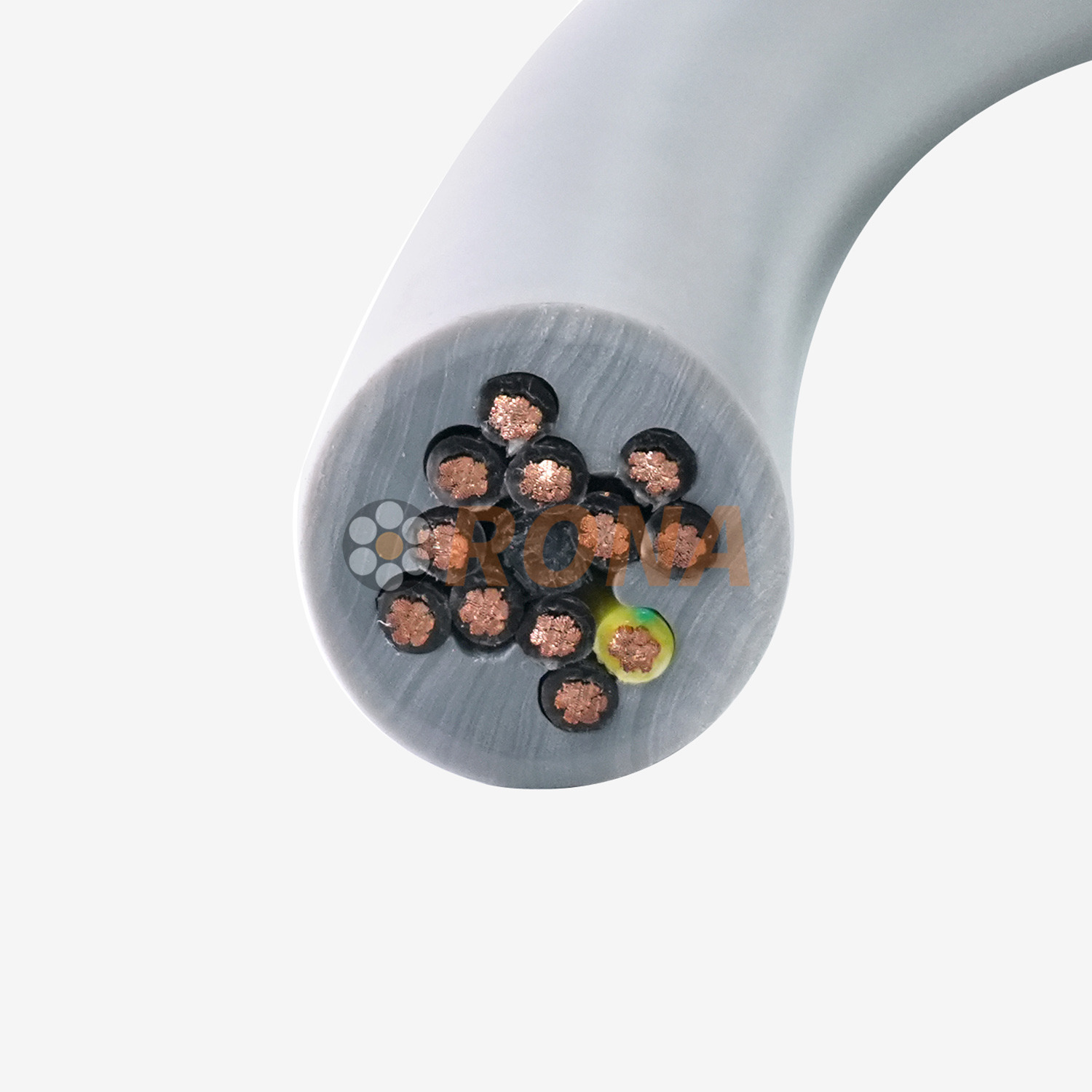
A PUR cable uses polyurethane as its outer sheath. PUR combines flexibility with strong mechanical and environmental resistance, making it suitable for industrial robots, drag chain systems, automated production equipment, CNC machinery, material handling systems, and port or outdoor equipment.
RONA PUR cables are available in different conductor, core, and shielding configurations for power, control, and signal transmission.
However, a PUR sheath alone does not make a cable suitable for continuous movement. The conductor stranding, insulation, core arrangement, bending radius, and overall structure must also be designed for dynamic operation.
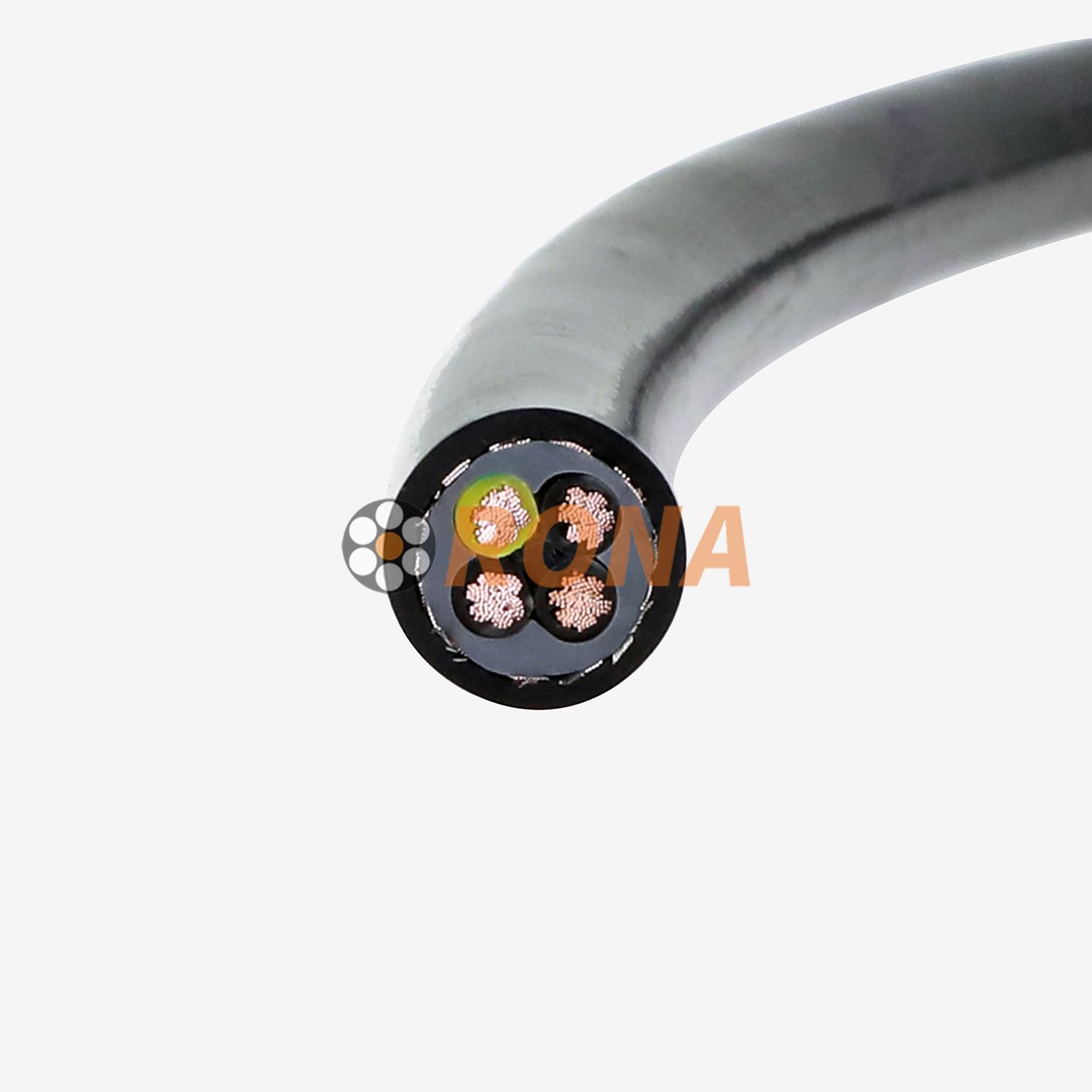
A PVC cable uses polyvinyl chloride as its outer sheath. PVC provides reliable mechanical protection, electrical insulation, and cost-effective performance under general industrial conditions.
PVC cables are commonly used in control cabinets, internal machine wiring, packaging machinery, CNC equipment, servo systems, sensors, actuators, and moderate-duty drag chains.
RONA PVC cables are available for power, control, and signal applications. Different insulation materials, conductor structures, core numbers, and shielding options can be selected according to the equipment requirements.
Cables in drag chains and mobile equipment frequently rub against cable carriers, machinery surfaces, or other cables. Continuous friction can gradually wear through the outer sheath.
PUR generally provides better abrasion resistance than standard PVC. Its tough surface makes it appropriate for equipment involving fast movement, frequent bending, or mechanical contact.
PVC still offers dependable protection in fixed installations and moderate-motion systems where abrasion is limited.
PUR is often selected for industrial robots and high-speed drag chains because it combines flexibility with resistance to fatigue and surface damage.
PVC can also support repeated movement, but the cable must be specifically designed for dynamic operation. Ordinary fixed-installation PVC cable should not be placed in a continuously moving drag chain.
When evaluating flexibility, buyers should consider the bending radius, travel distance, movement speed, acceleration, operating cycles, and installation method. Fine-stranded conductors, flexible insulation, balanced cores, and correct cable installation are equally important.
Industrial cables may be exposed to lubricants, coolants, cleaning products, and hydraulic oils. These substances can cause an unsuitable sheath to swell, soften, crack, or lose mechanical strength.
PUR generally offers stronger resistance to oils and many industrial chemicals. It is therefore a practical option for machine tools, automated production lines, and processing equipment where contact with industrial fluids is frequent.
PVC may be suitable for cleaner indoor areas or applications involving only occasional oil exposure. Because chemical resistance varies by formulation, buyers should identify the exact fluid, concentration, temperature, and exposure time before choosing a cable.
Low temperatures can make some cable jackets stiff and more likely to crack during movement. Suitable PUR compounds can maintain flexibility in refrigerated warehouses, outdoor automation systems, ports, and machinery operating in changing climates.
PVC performs reliably within normal indoor industrial temperature ranges. It is widely used in factories, cabinets, and machines operating in stable environments.
Outdoor installations also require consideration of UV exposure, rain, temperature changes, and mechanical wear. PUR is often the stronger choice for long-term outdoor use. PVC cables should only be used outdoors when the product specification confirms suitable UV and weather resistance.
PVC cables normally have a lower purchase price. For fixed indoor wiring or moderate-duty machinery, PVC can provide the required performance without unnecessary material costs.
PUR cables generally cost more, but their stronger resistance may provide a longer service life in harsh or continuously moving applications. This can reduce replacement work and production downtime.
Buyers should therefore compare total operating cost rather than price per meter. Maintenance access, replacement frequency, installation labor, and the cost of unexpected equipment shutdown should also be considered.
PUR cable is generally the better choice when the cable moves continuously or at high speed, severe abrasion is expected, oils or coolants are present, the equipment operates outdoors, low-temperature flexibility is required, or cable replacement would be difficult or expensive. Typical applications include robots, high-speed drag chains, automated warehouses, port machinery, and mobile industrial equipment.
PVC cable is usually suitable when the installation is indoors, movement is fixed, occasional, or moderate, oil and chemical exposure is limited, the operating temperature is stable, and budget is an important consideration. Typical applications include control cabinets, internal machine wiring, packaging equipment, sensors, servo systems, and moderate-duty drag chains.
Choosing between PUR and PVC is only one part of industrial cable selection. The operating voltage, maximum current, conductor cross-section, number of cores, allowable voltage drop, grounding requirements, and temperature-related derating should also be confirmed before ordering.
Shielding may be required where motors and drives can generate electromagnetic interference. Shielded cables help protect sensitive control and communication signals, but the shielding must be correctly terminated and grounded.
The type of movement must also be identified. Drag chain motion, torsion, reeling, vertical hanging, and trailing movement create different mechanical stresses. A drag chain cable is not automatically suitable for robotic torsion or drum reeling.
The bending radius should be checked carefully, using the dynamic value for cables operating in drag chains. Applicable CE, RoHS, VDE, IEC, or other project requirements should be confirmed for the specific cable configuration rather than assumed from the sheath material.
A common mistake is choosing a cable based only on whether its sheath is PUR or PVC. The complete cable structure must match the required movement, electrical load, and working environment.
Another mistake is selecting ordinary PVC cable for continuous flexing. If PVC is preferred for cost reasons, it should be a purpose-designed high-flex or drag chain cable.
Buyers should also avoid assuming that all PUR cables offer identical performance. Temperature, oil resistance, flexibility, UV resistance, chemical resistance, and bending capability can vary between products.
Providing complete operating information to the cable manufacturer is the safest way to receive a suitable recommendation.
No. PUR is more resistant to abrasion and harsh environments, but PVC can be more economical and fully suitable for indoor or moderate-duty applications.
Yes, if the cable is specifically designed for drag chain movement. Standard fixed-installation PVC cable should not be used for continuous flexing.
No. Outdoor suitability depends on the cable’s UV resistance, temperature rating, and complete construction. Always check the product specifications.
PUR is often preferred for industrial robots because of its abrasion resistance and flexibility. However, robotic applications also require a cable designed for the specified torsion angle, rotation direction, bending radius, and operating cycles.
PVC generally has a lower initial price. PUR may offer a lower total operating cost when its durability reduces replacement and equipment downtime.
PVC cable is a practical and economical choice for indoor machinery, general wiring, and moderate movement. PUR cable is more appropriate for applications involving continuous flexing, abrasion, oils, chemicals, outdoor exposure, or low temperatures.
The right choice depends on the complete application rather than the sheath material alone. By evaluating movement, bending radius, electrical load, environmental exposure, installation conditions, and expected service life, buyers can select an industrial cable that provides reliable performance without unnecessary cost.