

Views: 0 Author: Site Editor Publish Time: 2025-12-16 Origin: Site
Cable drag chains are often overlooked but play a vital role in industrial systems. Without them, cables and hoses would be exposed to damage, leading to costly repairs and downtime.
In this article, we’ll discuss the importance of drag chains, their types, uses, and the benefits they bring to industrial operations. You’ll learn how choosing the right cable management system can enhance efficiency and safety across various industries.
Cable drag chains are primarily designed to protect and organize cables and hoses in motion. By providing a stable path for the cables, they prevent tangling, wear, and damage. They also help in maintaining the integrity of the cables, allowing for longer service life.
In industries where equipment operates in dynamic or harsh conditions, cable drag chains are invaluable. These chains ensure that cables remain securely in place and are not subjected to unnecessary stress. By reducing friction and eliminating the risk of tangling, drag chains contribute significantly to the efficiency of the equipment, allowing it to run at peak performance for extended periods.
Additionally, drag chains play an essential role in reducing the risk of electrical failures, which can cause operational disruptions. They help prevent damage to power cables and signal cables by organizing them and keeping them safe from external forces, thus ensuring that equipment continues to perform optimally.
A typical cable drag chain consists of interconnected links that form a flexible path for cables and hoses. These links are designed to allow for smooth and controlled bending while supporting the cables in their entirety. The chain is often mounted on one end of the machine, while the other end moves along with the machine’s movement. This design allows the cables to follow a consistent path, preventing them from getting tangled or damaged.
Inside the drag chain, there are often dividers or compartments that help organize different cables and hoses, ensuring that they don’t come into contact with one another. This separation is particularly useful in systems where different types of cables (e.g., power cables, data cables, hydraulic hoses) need to be managed simultaneously. With the proper organization, there is a reduced chance of cross-contamination or signal interference, allowing cables to function without hindrance.
This level of organization is critical in preventing unnecessary downtime, as tangled cables or hoses are a major cause of malfunctioning equipment. By keeping everything neatly separated and protected, drag chains streamline operations and significantly improve efficiency.
While "drag chains" and "cable carriers" are commonly used interchangeably, there are subtle differences in the way these terms are applied across industries. "Cable carriers" is a more general term that describes any system designed to hold and protect cables, whereas "drag chains" often refers to chains that move along a set track, allowing cables to travel with the machinery’s movement.
Both terms refer to systems that prevent cables from getting tangled or damaged, but the term "drag chain" is typically used when there is a need for flexibility and movement, such as in robotic or CNC applications. Understanding the terminology helps in selecting the right product for your specific needs. This distinction ensures that businesses can make informed decisions regarding which system will best suit their operational requirements.
To clarify these terms, here’s a quick comparison of drag chains, cable carriers, and energy chains:
| Term | Definition | Usage |
|---|---|---|
| Cable Drag Chains | Flexible systems that guide and protect cables as they move | Used when cables need to follow a specific path with movement |
| Cable Carriers | A more general term for systems that protect and organize cables | Used interchangeably with "drag chains" in many contexts |
| Energy Chains | Another name for cable drag chains, particularly in high-tech systems | Commonly used in industries with high-tech machinery |
Steel Energy Chain
Plastic drag chain
| Type of Cable Drag Chain | Material | Strength | Flexibility | Applications | Advantages |
|---|---|---|---|---|---|
| Steel Cable Drag Chains | Steel | High | Low | Heavy-duty equipment, port cranes, mining | Durable, high load capacity, ideal for harsh environments |
| Plastic Cable Trays | High-performance polymers (e.g., Polyamide) | Moderate | High | Food processing, semiconductor production | Lightweight, corrosion-resistant, cost-effective |
| Hybrid Cable Drag Chains | Steel frame + plastic components | High | High | Robotics, automated systems, high-speed applications | Combines strength and flexibility, versatile |
Steel cable drag chains are known for their robust construction and high load-bearing capacity. Made from high-quality steel, these chains can withstand extreme environmental conditions, including high temperatures and heavy mechanical stress. As a result, they are ideal for use in heavy-duty applications such as port cranes, mining equipment, and large manufacturing machines.
The primary advantage of steel drag chains is their ability to provide excellent protection to cables while maintaining dimensional stability under heavy loads. They are built to last and can operate in environments where flexibility and durability are critical. Steel chains excel in extreme environments where cables and hoses are exposed to high temperatures, mechanical stress, or corrosive substances, providing reliable and consistent performance over time.
Plastic cable trays are a lighter, more flexible alternative to steel chains. Made from high-performance polymers like polyamide or polypropylene, these trays offer excellent resistance to corrosion, making them ideal for industries such as food processing and semiconductor manufacturing, where chemical resistance is important.
Plastic drag chains are easy to handle, reducing installation time and costs. They are also quieter than steel chains, making them suitable for noise-sensitive environments. While they may not be as durable under heavy loads, they are an excellent choice for medium-duty applications where flexibility and corrosion resistance are paramount. Plastic chains are also well-suited for cleanroom environments, where contamination from particles must be minimized.
Hybrid cable drag chains combine the best features of steel and plastic, offering a balance between strength and flexibility. These chains typically have a steel frame for structural stability, with plastic components used to reduce weight and increase flexibility. They are commonly used in applications that require both durability and mobility, such as robotics, high-acceleration machine tools, and automated systems.
The hybrid design allows businesses to optimize the performance of their equipment by selecting a solution that offers the right balance of flexibility, strength, and durability. Hybrid chains are particularly useful in applications where cables need to be supported while maintaining the ability to move freely without being subjected to excessive wear or stress.
The popularity of various types of cable drag chains can be broken down as follows:
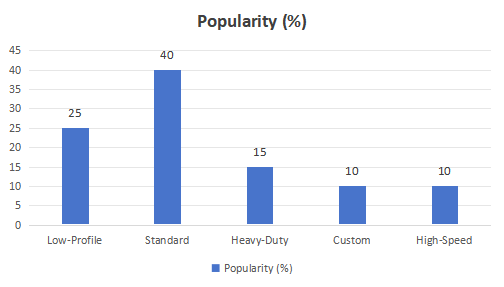
As shown in the chart, "Standard" cable drag chains are the most widely used, followed by "Low-Profile" and "Heavy-Duty" types. "Custom" and "High-Speed" types make up a smaller portion of the market. This distribution reflects the needs of various industries, with "Standard" chains being suitable for a wide range of applications.
Automation and robotics rely heavily on cable management systems to ensure smooth operation. Cable drag chains play a vital role in these applications by guiding and protecting cables as robotic arms or automated machinery move along predefined paths. By maintaining organization and reducing wear, drag chains ensure that cables continue to function properly, even during high-speed or complex movements.
Cable drag chains are also used in systems with high-acceleration or high-speed axes, where precise movement and cable protection are critical. With the added benefit of reducing downtime due to cable-related failures, these systems ensure that automation processes remain efficient and safe, reducing the overall cost of maintenance and increasing productivity.
In CNC machines, cable drag chains help organize power cables, signal cables, and hoses that are constantly in motion. By preventing tangling or damage, drag chains reduce maintenance costs and downtime, allowing for continuous, high-performance operation. This is particularly important in environments where precision and efficiency are key to the manufacturing process.
The ability to maintain organized cables also improves safety by minimizing tripping hazards and ensuring that no cables interfere with the machine's operation. With the added benefit of streamlined maintenance, businesses can focus more on production and less on managing cable-related problems.
Cranes and offshore rigs operate in challenging environments where heavy-duty equipment is required to manage cables and hoses. Steel cable drag chains are essential in these applications, as they provide the necessary strength and protection for cables that carry electricity, hydraulic lines, or even fluids.
With their high load-bearing capacity and resistance to harsh environmental conditions such as saltwater, steel drag chains ensure the reliability of cable systems, helping to avoid costly equipment failures or safety incidents in offshore drilling or crane operations. These chains play a critical role in maintaining continuous operations in environments where reliability and durability are non-negotiable.
Cable drag chains are also widely used in food processing, automotive production lines, and semiconductor manufacturing. In these industries, drag chains help manage cables in cleanrooms, protect sensitive electronics, and ensure smooth operations on automated production lines.
Whether it's protecting power cables in food packaging machines or guiding hydraulic lines in automotive assembly robots, drag chains help maintain the integrity of the systems, reducing downtime and improving efficiency across various sectors. They ensure that cables are properly guided and protected, improving safety and productivity in high-demand environments.
| Benefit | Explanation | Impact on Operations |
|---|---|---|
| Extended Cable Lifespan | Protects cables from wear, friction, and bending | Reduces replacement costs and minimizes operational downtime |
| Improved Workplace Safety | Keeps cables organized, preventing tripping hazards and electrical accidents | Increases worker safety and reduces injury risks |
| Boosted Operational Efficiency | Ensures cables stay in place and are properly guided | Minimizes downtime, enhancing overall productivity |
| Lower Maintenance Costs | Reduces cable damage and the frequency of repairs | Decreases maintenance costs and extends the lifespan of equipment |
Drag chains reduce cable wear by protecting cables from constant friction, abrasion, and bending. This leads to longer cable life, reduced replacement costs, and fewer interruptions in production. In addition, by organizing cables, drag chains reduce the risk of cables becoming tangled, which further contributes to extended service life.
By minimizing exposure to external elements and preventing unnecessary stress, drag chains help preserve the integrity of cables, ensuring that equipment remains functional for longer periods without the need for costly replacements.
One of the most important benefits of using cable drag chains is the improved safety they provide. By keeping cables organized and secure, drag chains help prevent tripping hazards that could lead to injuries. In environments where workers are exposed to high-speed machinery, ensuring cables stay in place is critical for minimizing accident risks.
In addition to reducing physical hazards, drag chains also improve electrical safety by preventing cables from coming into contact with dangerous moving parts, ensuring that electrical connections remain secure throughout the operation.
Cable drag chains help increase operational efficiency by keeping cables properly organized and reducing the likelihood of cable-related malfunctions. This not only ensures that machines run smoothly but also decreases downtime, leading to higher productivity and lower maintenance costs.
By providing a dedicated path for cables to travel along, drag chains also reduce the time needed for troubleshooting and repairs, as technicians can easily locate and access cables when necessary. This streamlined process helps businesses maintain continuous operations, reducing the cost of maintenance and improving overall efficiency.
By minimizing the wear and tear on cables and reducing the chances of failure, drag chains help lower maintenance costs. Fewer cable replacements and less frequent troubleshooting mean that businesses can focus on optimizing their operations instead of dealing with downtime caused by cable damage.
Drag chains also contribute to reducing repair costs by preventing damage to other components that could occur if cables were left unmanaged. By keeping cables in a safe, organized position, drag chains prevent costly equipment failures that could otherwise lead to significant operational disruptions.
| Sizing Considerations | Explanation | Installation Tips |
|---|---|---|
| Cable Dimensions | Ensure the chain’s internal height and width are sufficient for cables | Keep cables organized and avoid overfilling the chain |
| Bend Radius | The bend radius should be larger than the minimum required for cables | Ensure adequate clearance for smooth movement of cables |
| Load Capacity | Consider the load-bearing needs based on machinery and cable weight | Ensure drag chain supports the total weight of cables and hoses |
| Environmental Conditions | Choose materials based on temperature, humidity, and chemical exposure | Select corrosion-resistant materials for harsh environments |
When choosing a cable drag chain, it's important to consider both the load capacity and environmental conditions. Heavy-duty applications may require steel drag chains, while lighter environments or cleanroom settings may benefit from plastic or hybrid options. Additionally, understanding the temperature, humidity, and chemical exposure in your operating environment will help determine the right material for your drag chain.
Choosing the appropriate drag chain based on these factors ensures that you get a system that will provide reliable performance without unnecessary wear or maintenance issues. Taking the time to evaluate your needs can help you make an informed decision that will benefit your operations in the long term.
Selecting the right size for your cable drag chain is critical for ensuring optimal performance. Start by determining the dimensions of the cables and hoses that will be housed inside the chain. The inner height and width of the chain should be large enough to accommodate all cables without overfilling, as excessive filling can cause friction and wear. Also, ensure that the minimum bend radius of the drag chain exceeds the required limits for your cables to avoid damage.
Correctly sizing the drag chain ensures that it provides sufficient support and protection for cables while maintaining flexibility and reducing the risk of premature wear.
Proper installation and regular maintenance are essential to the longevity of cable drag chains. Ensure that the drag chain is securely mounted and that there is enough clearance for the cables to move smoothly. Regularly inspect the chain for signs of wear and replace any damaged links or parts. Clean the chain periodically to prevent debris from accumulating inside.
Taking these simple steps helps maintain the efficiency of the system and ensures that cables are properly protected, reducing the likelihood of damage and extending the service life of both the drag chain and the cables.
As industries continue to evolve, so does the technology behind cable drag chains. Future innovations are focusing on smarter drag chains that include sensors for predictive maintenance. These smart drag chains can monitor their own condition, alerting operators when repairs are needed before a failure occurs. Additionally, the use of lightweight and sustainable materials is on the rise, further improving the performance and environmental footprint of drag chain systems.
These advancements are helping businesses increase efficiency, reduce costs, and improve the longevity of their equipment. The continuous evolution of drag chain technology ensures that industries have access to more reliable and cost-effective solutions for managing cables.
Cable drag chains are essential in modern industrial applications. They offer benefits like extended cable lifespan, improved safety, and reduced maintenance costs. Whether used in high-speed machinery, robotic systems, or heavy-duty equipment, selecting the right drag chain ensures smooth and efficient operations. By investing in quality products, businesses can reduce downtime and optimize productivity.
At this point, companies like RONA provide valuable cable management solutions, helping businesses streamline their operations. RONA's products offer exceptional durability and functionality, ensuring long-lasting performance and safety in various industries.
A: Cable drag chains, also known as cable carriers, are systems designed to guide and protect cables and hoses in motion. They help prevent tangling, wear, and damage, ensuring cables remain intact and functional.
A: Drag chains consist of interlinked segments that support and organize cables, allowing them to move smoothly with machinery. They help reduce friction and prevent damage during high-speed or heavy-duty operations.
A: Drag chains ensure cable longevity, reduce maintenance costs, and improve safety. They keep cables organized, preventing damage caused by wear, friction, and entanglement in various industrial settings.
A: The main types of drag chains include steel, plastic, and hybrid. Steel chains are ideal for heavy-duty applications, while plastic chains are lighter and corrosion-resistant, perfect for clean environments.
A: Drag chains organize cables, preventing them from becoming tangled or exposed, reducing tripping hazards and electrical failures, and ensuring a safer working environment.


